T1A FOUNDATIONAL EXERCISE
Project Description:
This project aims to help me develop a strong understanding of design fundamentals, with an emphasis on the basics of design and spatial thinking. It introduces key design elements, principles, and techniques, while also guiding me through the design process and the importance of documenting each stage of development.

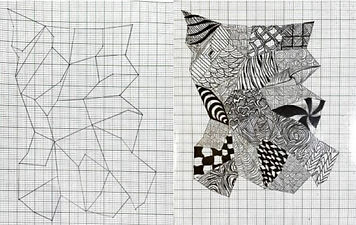

9 GRID: THE FOLLY
Project Description:
This project requires students to design a folly based on a friend acting as the client. Through this process, students develop a design intent and apply key design principles explored in the previous project, T1A.

PARTI-MODEL

FIRST STOREY PLAN
Through the construction of a 9-grid styrofoam parti model, I investigated spatial hierarchy and solid–void relationships by carving openings within the grid to accommodate my client’s leisure activities, including performance and reading.
Design Intent: To create a space for escape, a place where the user can be alone with her thoughts to write and draw. She is a quiet and empathetic individual who values privacy, and the space is conceived as a small, intimate retreat that allows her to remain within her own comfort zone.
SECOND STOREY PLAN

Project Description: This project explores a dwelling designed around the user’s spatial needs, shaped by her passions, interests, social interactions, and work life, while responding sensitively to site-specific conditions. A holistic design approach is adopted to express the user’s unique identity through space, integrating bioclimatic and biophilic strategies to promote sustainable architecture and thermal comfort within a tropical context.
DWELLING:
A HYBRID LIVING SPACE

Design Intent: To create a space whereby she is able to gather inspiration from the fusion of nature with living space and surrounding vast greenery. She is able to connect with the natural world and create patterns of nature which are incorporated into her clothing collection


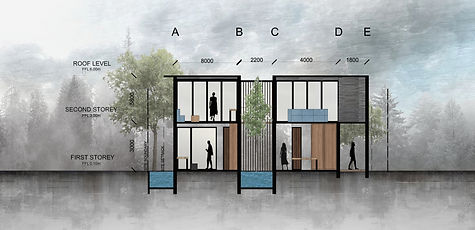


Design Strategy: By designing living spaces for relaxation, invigorative and introspective, it can infuse natural elements such as water feature, greenery, rocks within the living space
PARTI-MODEL
FIRST STOREY PLAN
SECOND STOREY PLAN
ELEVATION
SECTION
YEAR 2
PRECEDENT STUDY:
THE OLIV BY W ARCHITECTS
Project Description:
This project aims to conduct a precedent study of a local multi-storey housing project through research and analysis. Relevant information is gathered by observing, interpreting, critiquing, and deriving conclusions using hand-drawn diagrams as the primary method of investigation. The observations and conclusions drawn from this study provide a deeper understanding of key architectural aspects and areas of focus, enabling the application of this knowledge to future assignments and design projects.


SITE PLAN
SPATIAL PLANNING: LOWER FLOOR

SPATIAL PLANNING: UPPER FLOOR

RESIDENTIAL DEVELOPMENT @ LORONG 9 GEYLANG
Project Description:
Proposed new erection of 1 block of 8-storey residential development compromising of 44 units with Ancillary Facilities at No. 51 Lorong 9 Geylang on Lot No. MK24 - 99935N

LOCATION PLAN

Design Issue:
As Geylang attracts a diverse demographic, ensuring social inclusivity and community cohesion will be essential
DESIGN CONCEPT
BLOCK
PUSH

PULL
SUBTRACT
Design Intent: As new amenities, schools, and transport links are developed in Geylang over the years, the development proximity to these conveniences will become a significant selling point. Families, professionals, and retirees will find the location increasingly attractive due to the enhanced lifestyle offerings. As Geylang develops and attracts more families, the demand for larger living spaces will likely increase. These flats can cater to families seeking more space and comfort.
Design Strategy: Creating multiple communal spaces on the ground level as well as incorporating duplex communal sky terraces at certain levels of the development to enhance social cohesion
DESIGNING WITH COMPLIANCE


TYPICAL FLOOR PLAN

EXPLODED ISOMETRIC VIEW

YEAR 3
HEARTH CIRCUIT
Project Description:
Proposed Erection of 7-Storey Educational Institution with first-storey carpark on lot MK03-05219V at 500 Dover Road S139651 (Queenstown Planning Area

SITE PLAN
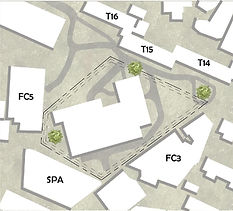
Design Issue:
As Geylang attracts a diverse demographic, ensuring social inclusivity and community cohesion will be essential


Climatic Orientation:
Building rotation responds to prevailing NE and SE winds, allowing natural ventilation through the atrium and porous massing.
Key Views:
Terraces are positioned to capture key views of North-West, South-West and North-East while minimising exposure to harsh west sun
DESIGN CONCEPT


1
2
3
4
Establish a compact L-shaped block responding to site boundaries
Introduce openings to create courtyards and improve spatial permeability
Orient and shape the form to capture prevailing winds and optimize the sun path
Refine terraces and circulation to enhance connectivity and social interaction.
Key Design Concept:
A layered engineering school shaped by systems biomimicry, where learning and collaboration flow like a circuit around a central social hearth. The spatial journey mimics an engineering workflow, at the same time, every level is visually connected to the atrium

4
5
6
Expanded the carpark and improved movement flow, ensuring smoother site and building connectivity
Enclosed the central atrium to test thermal comfort and environmental control through air-conditioning.
Optimized the atrium by combining air- conditioning with natural ventilation for efficiency.
SPATIAL JOURNEY

ROOF
2
1
3
4
5
6
7
PROGRAMMING CONSOLIDATION

ROOF
2
1
3
4
5
6
7

Inaccessible Roof
Solar Panels
Air-cooled Chiller System
Lecture Theatre
Faculty Office
DC Microgrid
Outdoor Garden
Discussion Lounge
Faculty Office
SECTION


